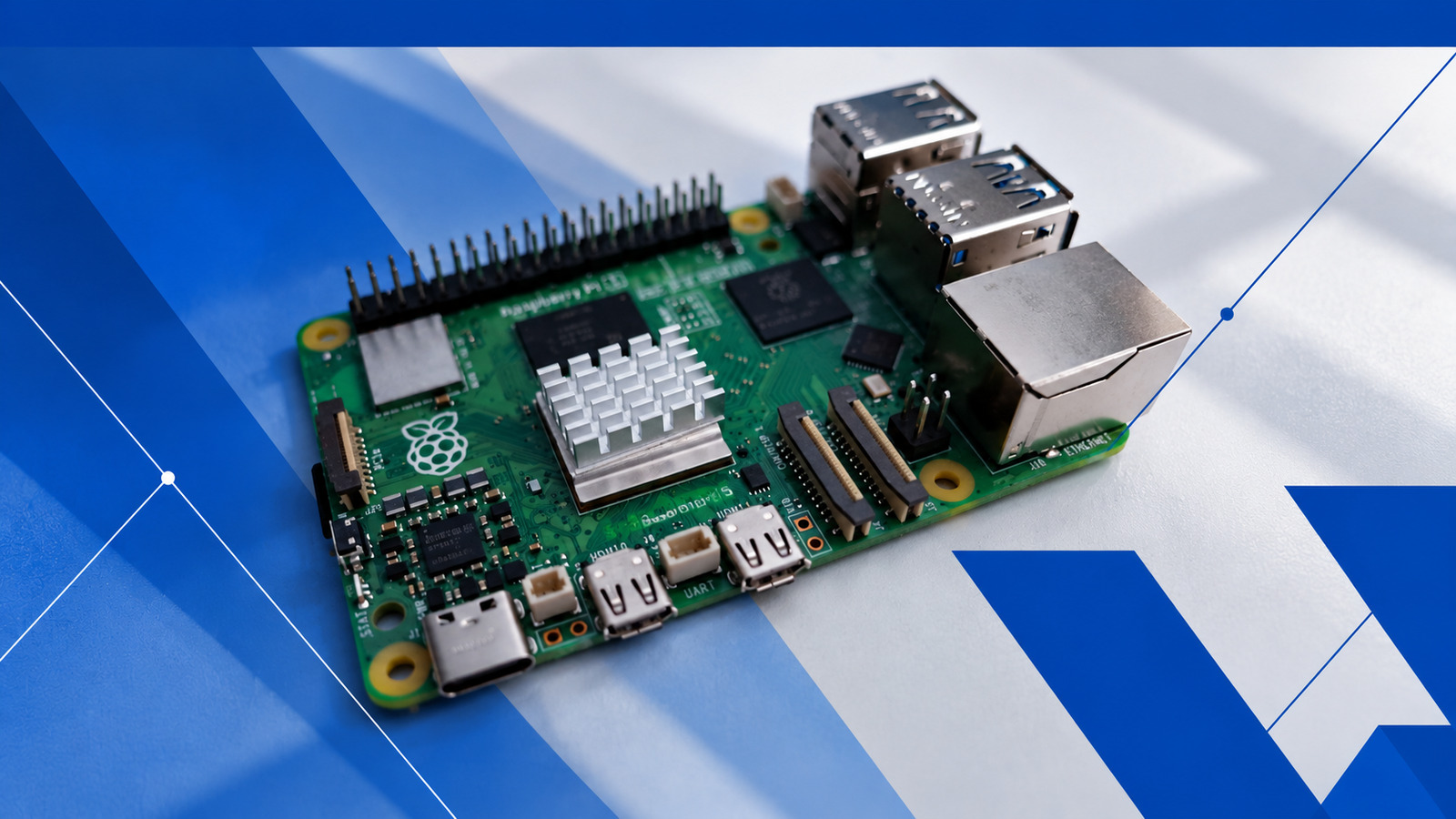
Raspberry Pi just delivered the kind of numbers that make a market headline easy: revenue up 90 per cent and pre-tax profit more than tripled. The more interesting story is where some of the demand is coming from.
The Cambridge computing company reported first-half revenue of $256.9m and pre-tax profit of $19.6m for 2026, alongside 4.2m unit shipments and a backlog that had doubled to 2.6m units. Price increases and a well-timed stockpile of memory components helped the financial performance, so it would be wrong to present artificial intelligence as the sole engine of growth.
But buried inside the results is a much more useful signal. Raspberry Pi says it has seen a specific increase in customers using its products for edge-AI inference: running AI models locally on devices rather than sending every request to a remote data centre.
The cloud is not disappearing. The edge is becoming intelligent
Most of the AI boom has been described through giant infrastructure: hyperscale data centres, accelerator clusters, power contracts and billion-dollar capital budgets. That is necessary for training the largest models. It does not mean every useful AI task needs to happen there.
Inference is different. Once a model exists, many applications can run smaller or specialised versions close to the user: in a camera, factory, vehicle, retail device, home system or piece of industrial equipment. Raspberry Pi’s AI HAT+ 2 is explicitly designed to let the Raspberry Pi 5 run more sophisticated workloads locally, including language and vision models.
That changes the economics. A cloud call can be extremely capable, but it also introduces latency, network dependency and a recurring cost. Local inference can continue when connectivity is poor, keep sensitive information on the device and respond faster to real-world events.
Privacy may become a hardware feature
The privacy argument is particularly important. Consumers and businesses increasingly want the usefulness of AI without sending every audio sample, image or operational datapoint to a third-party server.
Edge systems cannot eliminate privacy risk, but they can change the data flow. A smart camera that identifies an event locally does not necessarily need to upload a continuous video stream. An industrial system can detect anomalies without exporting every sensor reading. A personal device can perform some language or vision tasks while keeping the raw input nearby.
That gives hardware companies an opportunity that was easy to overlook during the first phase of generative AI. If intelligence moves into ordinary devices, the competitive question is not only who owns the biggest model. It is who provides the cheapest, most reliable place to run the right model.
Raspberry Pi sits in an unusual part of that market
Raspberry Pi began life as an affordable educational computer, but a large part of its business now comes from industrial and commercial customers. Its results point to strong demand in smart-home applications and growing interest across the broader embedded-computing market.
That matters because edge AI is unlikely to be won by one category of device. It will be distributed across millions of relatively modest machines. In many cases, good enough, cheap, available and programmable is more valuable than maximum benchmark performance.
Raspberry Pi also has an advantage in its developer ecosystem. Engineers have spent years using its boards to prototype products. As AI accelerators become easier to attach and software support improves, prototypes can become production workloads without requiring an entirely new computing stack.
The financial result contains a warning too
There is a second AI connection in the numbers, and it is less comfortable. Global demand for memory has pushed component costs higher. Raspberry Pi had protected itself by building inventory before prices rose, but the company says much of that benefit has now run through. Average selling prices increased materially as higher memory costs were passed to customers.
So AI is helping create demand at one end of the business while contributing to component pressure at the other. That is a useful reminder that the AI economy is not a single trade. It changes demand for compute, memory, power, networking and devices simultaneously.
What happens next
The next phase of AI adoption will be quieter than the chatbot boom. It will show up in machines that do not advertise themselves as AI products at all: inspection systems, appliances, robots, industrial controllers and personal devices.
Raspberry Pi’s half-year numbers do not prove that edge AI has won. They do show that it is moving beyond the lab. The cloud built the first visible wave of generative AI. The next one may arrive inside the objects already around us.
Sources & verification
Lead report: City A.M., 24 September 2026.
Primary financial source: Raspberry Pi investor relations — Interim Results 2026. The company reports $256.9m revenue, $19.6m profit before tax, 4.2m unit shipments and a 2.6m-unit backlog for the period.
The company’s interim report also identifies increased use of Raspberry Pi products for edge-AI inference and describes AI HAT+ 2 as supporting more sophisticated local AI workloads. Revenue growth also benefited from higher memory-related pricing, which is why this article does not attribute the full financial increase to AI demand.